
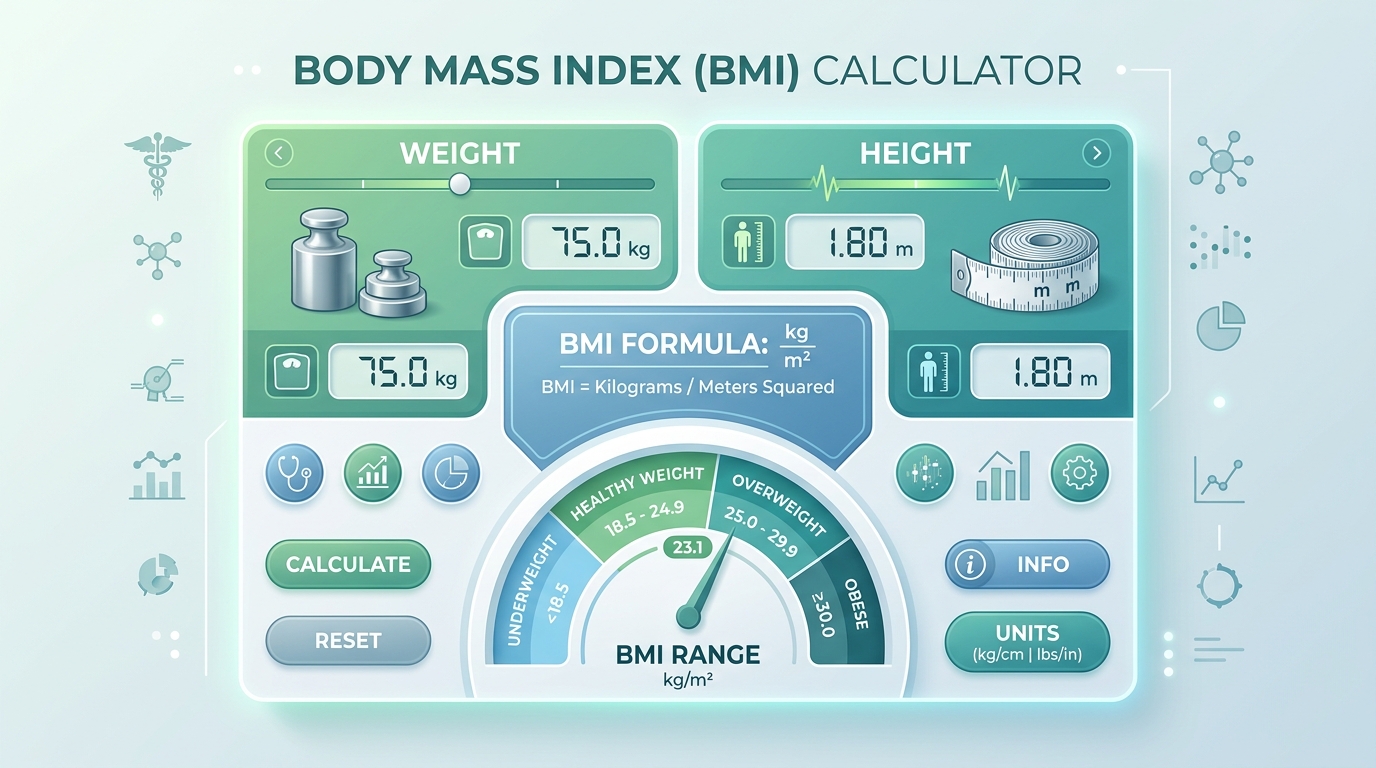
When evaluating physical wellness, personal fitness, or routine medical check-ups, one of the most common screening numbers you will encounter is Body Mass Index (BMI). Derived from a simple comparison of a person’s weight relative to their height, BMI has been used by public health organizations and healthcare providers worldwide for decades as an accessible initial screening tool. Using an online BMI calculator allows adults to calculate their score in seconds without manual arithmetic.
Body Mass Index is an initial statistical screening measure, not an individualized medical diagnosis. BMI does not directly measure body fat, evaluate body composition, or distinguish lean muscle mass from fat tissue. A single calculation cannot determine whether an individual is healthy or unhealthy. This guide is for educational purposes and should never replace personalized medical advice, diagnosis, or clinical guidance from a qualified healthcare professional.
Try All in One Toolbox BMI Calculator
Calculate your Body Mass Index score using your weight in kilograms and height in centimeters. Fast, neutral, and 100% private in your browser.
What Is Body Mass Index (BMI)?
Body Mass Index (BMI) is an anthropometric ratio that evaluates a person’s total body weight in relation to their height squared. First developed in the 1830s by Belgian statistician, mathematician, and sociologist Adolphe Quetelet (originally termed the Quetelet Index), the formula was devised to describe the average physical characteristics of populations rather than diagnose individual health status.
In the 1970s and 1980s, epidemiological researchers demonstrated that BMI correlates moderately with laboratory measures of total body fat across broad population cohorts. Consequently, the World Health Organization (WHO) and public health agencies adopted BMI as a practical, non-invasive screening tool to track population-level weight trends and identify potential health risks associated with underweight status or obesity.
However, it is equally critical to understand what Body Mass Index does not measure:
- Body Fat Percentage: BMI measures total mass; it does not reveal what fraction of that mass is fat, bone, muscle, or water.
- Fat Distribution: BMI cannot determine where fat is stored. Visceral fat surrounding abdominal internal organs carries distinctly different cardiometabolic risks compared to subcutaneous fat stored around the hips and thighs.
- Muscle Mass & Density: Dense skeletal muscle weighs more per unit of volume than adipose tissue. As a result, fit athletes and strength-trained individuals frequently register high BMI scores despite having low body fat percentages.
- Cardiorespiratory Fitness: BMI provides zero information regarding heart rate, lung capacity, aerobic stamina, or athletic conditioning.
- Nutritional Quality & Metabolic Markers: A person within the “healthy weight” BMI range may have elevated cholesterol, hypertension, or high blood glucose, while an individual in the “overweight” category may possess robust metabolic health.
In clinical medicine, BMI is treated as a starting conversation rather than a definitive conclusion. Physicians use it alongside patient medical history, family genetics, blood pressure readings, lipid panels, dietary patterns, and lifestyle habits to form a comprehensive assessment.
How to Calculate BMI: The Mathematical Formulas
Body Mass Index is calculated using one of two standard mathematical formulas, depending on whether you measure your dimensions using metric units or imperial units:
1. The Metric Formula (Standard Global Method)
In the International System of Units (SI), weight is measured in kilograms (kg) and height is measured in metres (m):
Worked Metric Example: Consider an adult who weighs 70 kg and stands 1.75 metres tall (175 cm):
- First, square the height in metres:
1.75 × 1.75 = 3.0625. - Next, divide the weight by the squared height:
70 ÷ 3.0625 = 22.857... - Rounding to one decimal place yields a BMI of 22.9, which falls within the standard healthy adult weight range.
2. The Imperial Formula (US Customary Method)
When weight is measured in pounds (lb) and height is measured in inches (in), a conversion multiplier factor of 703 is applied to align the result with metric scales:
Worked Imperial Example: Consider an adult who weighs 154 lb and stands 70 inches tall (5 feet 10 inches):
- First, square the height in inches:
70 × 70 = 4,900. - Next, multiply weight by the conversion factor:
703 × 154 = 108,262. - Finally, divide the product by the squared height:
108,262 ÷ 4,900 = 22.094... - Rounding to one decimal place yields a BMI of 22.1, which also falls firmly within the standard adult healthy weight range.
Note: Because these worked examples represent two different illustrative body measurements, their rounded results (22.9 vs 22.1) are naturally distinct.
If you know your height in feet and inches or your weight in pounds, you can convert them to metric units using our free Unit Converter before calculating your score.
How to Use the All in One Toolbox BMI Calculator
All in One Toolbox provides a lightweight, instant BMI Calculator that executes directly inside your browser. Follow these simple steps:
- Open the Tool: Navigate to the All in One Toolbox BMI Calculator page.
- Enter Your Weight (kg): Type your current body weight in kilograms into the “Weight (kg)” input field (for instance,
70). - Enter Your Height (cm): Enter your height in centimeters into the “Height (cm)” input field (for instance,
175for 1.75 metres). - Click Calculate: Press the Calculate button to process the values.
- Review Your Result: The tool displays your numerical BMI score alongside its standard category label (e.g., “BMI 22.9 — Healthy range”).
- Reset Anytime: Click the Reset button if you wish to clear the inputs and start over.
Ready to calculate your score?
Input your height and weight for an instant, private screening score.
Standard Adult BMI Categories
For adults aged 20 years and older, public health agencies including the World Health Organization (WHO) and the US Centers for Disease Control and Prevention (CDC) classify BMI scores into four primary screening categories:
| BMI Range (kg/m²) | Standard Adult Category | Public Health Clinical Interpretation |
|---|---|---|
| Below 18.5 | Underweight | May indicate malnutrition, vitamin deficiencies, lower bone mineral density, or underlying health concerns. A clinician can help assess whether caloric intake or nutrient absorption is adequate. |
| 18.5 to below 25.0 | Healthy weight / Healthy range | Associated with the lowest statistical population risk for cardiovascular disease, type 2 diabetes, and weight-related chronic conditions. |
| 25.0 to below 30.0 | Overweight | Indicates body mass above statistical norms. For individuals with sedentary lifestyles, it may signal elevated cardiometabolic risk; for muscular individuals, it may simply reflect high lean muscle mass. |
| 30.0 or above | Obesity / Obese | Subdivided clinically into Class 1 (30.0–34.9), Class 2 (35.0–39.9), and Class 3 (≥40.0 severe obesity). Statistically linked to higher incidence of hypertension, sleep apnea, osteoarthritis, and cardiovascular illness. |
Important Qualification: These classifications apply uniformly across adult age groups and sexes for epidemiological statistical tracking. They should never be interpreted in isolation as an individual diagnosis.
How to Read Your BMI Result Responsibly
Viewing your calculated BMI number can evoke strong emotional reactions, especially in a culture saturated with intense body aesthetics. Understanding how to interpret your score with scientific nuance helps maintain a balanced, healthy perspective:
1. View It as a Single Screening Clue, Not a Report Card
A high or low BMI score is not a personal failure, nor does a “healthy weight” score confer total immunity from illness. Think of BMI like a blood pressure cuff: an initial screening measurement that suggests whether further investigation or lifestyle discussion might be helpful.
2. Consider Your Body Composition
If you engage in regular resistance training, weightlifting, rugby, or high-intensity athletics, your dense skeletal muscle mass may elevate your BMI into the overweight or obese bracket. Conversely, an adult with very low muscle mass may have a normal BMI while carrying elevated visceral fat.
3. Focus on Holistic Health Habits Over Rapid Weight Drops
Health organizations consistently emphasize that sustainable, long-term health is built on consistent physical movement, nutrient-dense nutrition, restorative sleep, and mental well-being—never on extreme caloric restriction, crash diets, or rapid weight loss.
BMI for Children and Teenagers: Why Adult Charts Do Not Apply
A vital clinical rule in pediatric health is that adult BMI category cutoffs must NEVER be applied to children or teenagers (individuals aged 2 to 19 years old).
Here is why pediatric BMI calculation is fundamentally different:
- Rapid Growth & Development: Children undergo intense skeletal, hormonal, and muscular growth spurts. Height and weight change at varying rates throughout infancy, childhood, and puberty.
- Age & Biological Sex Variations: The amount of body fat naturally fluctuates significantly as children mature, and these physiological patterns differ substantially between boys and girls at different stages.
- Percentile-Based Tracking (CDC Growth Charts): Instead of static threshold numbers (such as 18.5 or 25), pediatricians calculate BMI and plot it onto age-and-sex-specific growth percentile charts:
- Underweight: Below the 5th percentile for age and sex.
- Healthy weight: 5th percentile to below the 85th percentile.
- Overweight: 85th percentile to below the 95th percentile.
- Obesity: 95th percentile or greater.
All in One Toolbox’s BMI calculator uses standard adult screening thresholds. If you are evaluating a child or adolescent, do not use adult calculators. Please consult your child’s pediatrician or refer to official pediatric growth charts provided by the CDC or NHS to interpret a child’s growth patterns accurately.
Limitations of BMI: What the Number Misses
While BMI remains widely utilized in public health surveys because it is inexpensive, non-invasive, and mathematically straightforward, it has well-documented limitations when applied to individuals:
1. Does Not Distinguish Muscle from Fat
A 6-foot tall professional rugby player weighing 225 pounds has a BMI of 30.5 (“obese”), despite possessing 10% body fat and extraordinary cardiovascular conditioning. Because the formula treats every kilogram of mass identically, it frequently misclassifies athletic, muscular individuals.
2. Ignores Fat Distribution (Visceral vs. Subcutaneous)
Extensive medical research confirms that excess intra-abdominal fat (visceral fat around vital organs) poses significantly higher risks for cardiovascular disease and insulin resistance than peripheral subcutaneous fat stored in the limbs or hips. Two adults with an identical BMI of 27 can have vastly different metabolic risk profiles based on where their fat is deposited.
3. Age-Related Shifts in Body Composition
As adults age, muscle mass naturally declines (a process known as sarcopenia) while body fat percentage tends to increase, even if total weight remains static. In fact, geriatric studies suggest that for adults over 65, a slightly higher BMI (around 25–27) may be protective against bone fractures, osteoporosis, and nutritional frailty. You can explore how age influences wellness timelines with our Age Calculator.
4. Ethnic and Genetic Variations
The World Health Organization has noted that standard BMI cutoffs (developed primarily from data on populations of European descent) do not apply equally across all ethnicities. For instance, individuals of South Asian, East Asian, and Pacific Islander heritage often exhibit higher body fat percentages and increased risks for cardiovascular disease and type 2 diabetes at lower BMI values (leading some health bodies to recommend thresholds of 23 for overweight and 27.5 for obesity in Asian populations).
BMI, Body Fat, and Overall Health: What Is the Difference?
To understand physical well-being comprehensively, it helps to distinguish four commonly confused health concepts:
| Measurement / Concept | How It Is Measured | What It Tells You | Primary Clinical Strength & Limit |
|---|---|---|---|
| Body Mass Index (BMI) | Weight divided by height squared. | Relative weight-to-height proportion. | Fast, zero-cost screening tool; does not measure body fat or muscle mass. |
| Body Fat Percentage | DEXA scan, hydrostatic weighing, bioimpedance, or skinfold calipers. | Proportion of total body weight composed of adipose tissue. | Accurately distinguishes muscle from fat; requires specialized equipment. |
| Waist Circumference | Measuring tape around the abdomen at the level of the navel. | Presence of central abdominal (visceral) adiposity. | Excellent cardiometabolic risk indicator; does not account for overall frame size. |
| Comprehensive Health Status | Blood tests, blood pressure, fitness tests, family history, lifestyle. | True metabolic, cardiovascular, and physiological vitality. | The gold standard for medical health; cannot be summarized in any single number. |
Common BMI Calculation Mistakes to Avoid
When calculating BMI manually or entering data into online tools, several common arithmetic and procedural errors can distort results:
1. Using Centimetres Directly Without Converting to Metres
In the metric formula, height must be in metres, not centimetres. If you divide 70 kg by 175 squared (30,625), you will get an absurdly tiny number (0.0022). Remember that 175 cm equals 1.75 m.
2. Mixing Metric and Imperial Units
Entering weight in pounds but height in metres—or weight in kilograms with height in inches—produces completely inaccurate values. Ensure your units are strictly consistent with the formula you select.
3. Entering Feet and Inches as Decimals Incorrectly
Standing 5 feet 6 inches tall does not mean “5.6 feet”. Because there are 12 inches in a foot, 5 feet 6 inches equals (5 × 12) + 6 = 66 inches.
4. Forgetting the 703 Multiplier in the Imperial Formula
If calculating in pounds and inches, omitting the conversion multiplier 703 produces an incongruous number below 1.0.
Sources and Further Reading
To ensure factual integrity and clinical accuracy, the health standards, categories, and epidemiological guidance in this article are aligned with the following official public health authorities:
- World Health Organization (WHO): Body mass index - BMI classification and Global Health Observatory standards. Provides international reference guidelines for adult weight categories and regional ethnic risk thresholds.
- Centers for Disease Control and Prevention (CDC): About Adult BMI & Child and Teen BMI Percentiles. Outlines standard United States clinical definitions, pediatric growth curves, and screening limitations.
- UK National Health Service (NHS): Body mass index (BMI) healthy weight guidance and waist measurement advice. Offers practical public guidance on interpreting weight metrics in holistic lifestyle contexts.
- National Institutes of Health (NIH): Assessing Your Weight and Health Risk. National Heart, Lung, and Blood Institute (NHLBI) guidelines on clinical evaluation of obesity and cardiovascular markers.
100% Client-Side Privacy: Your Health Metrics Stay Private
Personal health numbers are deeply sensitive. Many commercial health portals record your height, weight, IP address, and demographic profile to build targeted advertising profiles. All in One Toolbox does not work that way.
Client-Side Architecture Guarantee
Zero Server Storage · Zero Health Data Collection · 100% Private
Every calculation in All in One Toolbox’s BMI Calculator executes entirely inside your web browser’s local JavaScript memory. No height, weight, or calculated BMI values are ever sent to any remote server or logged in any database. You can even disconnect your Wi-Fi and use the calculator completely offline.
Calculate Your BMI With All in One Toolbox
Get an instant, neutral mathematical screening score for your height and weight in a clean, private browser utility.