
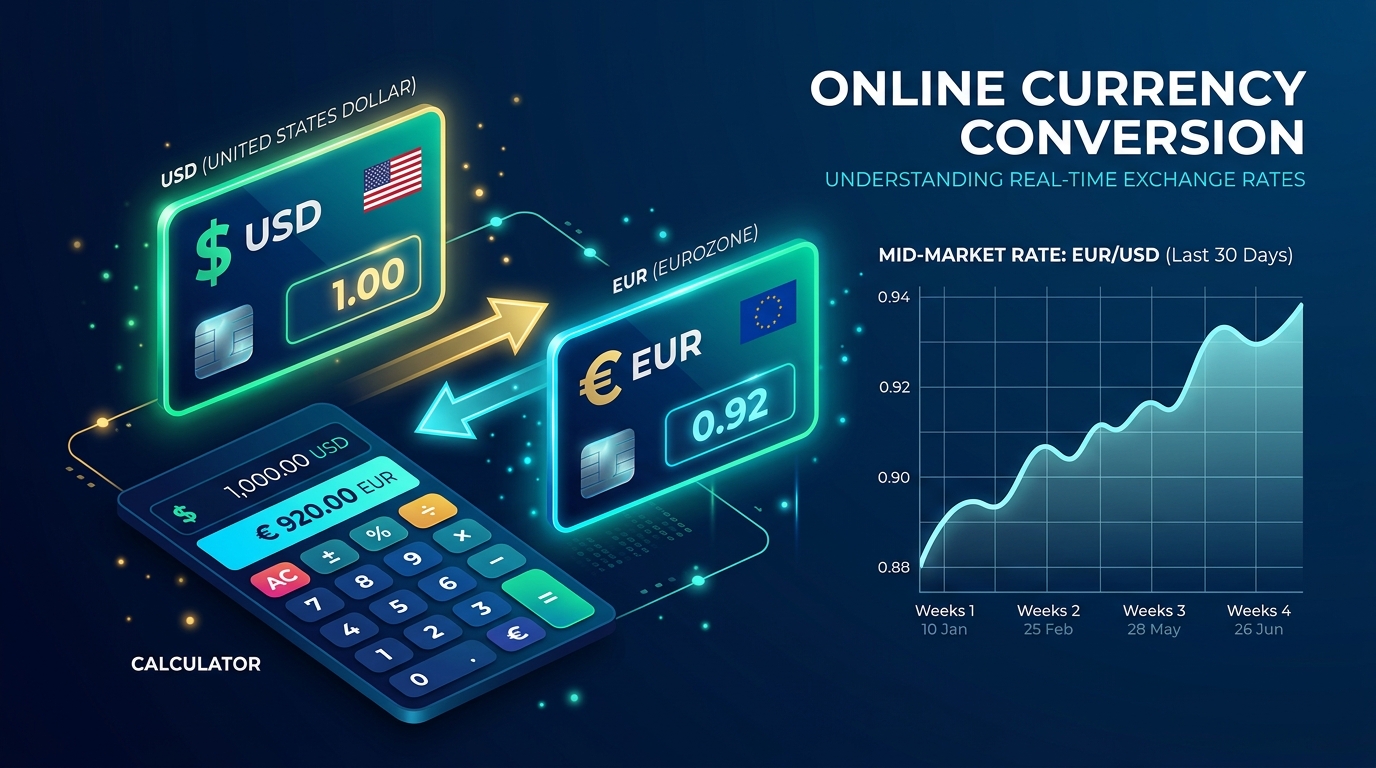
In today’s interconnected global economy, cross-border financial transactions touch our everyday lives more than ever before. Whether you are budgeting for an international vacation, managing cross-border freelance invoices, purchasing software from an overseas vendor, paying university tuition abroad, or sending hard-earned remittances home to family, understanding international exchange rates is essential. Using an online currency converter allows you to estimate the true equivalent value of your money across 160+ world currencies instantly using transparent mid-market reference rates.
A currency converter calculates estimated equivalent values based on wholesale mid-market reference rates. It does not execute money transfers, provide financial investment advice, or guarantee the exact retail quote offered by commercial banks, credit card networks, or airport exchange booths, which typically incorporate retail spreads and transaction fees.
What Is a Currency Converter?
A currency converter (also referred to as a foreign exchange calculator or FX calculator) is a digital tool that determines the monetary value of a specified sum in one currency relative to another. It does this by multiplying the source amount by the current exchange rate between the two sovereign currencies.
Currencies are identified globally using standardized three-letter alphabetical codes governed by the International Organization for Standardization (ISO 4217). Common examples include:
- USD (United States Dollar): The world’s primary global reserve currency, widely used for international commodities like crude oil and global trade invoicing.
- PKR (Pakistani Rupee): The official currency of Pakistan, frequently converted for overseas family remittances, imports, and regional commerce.
- EUR (Euro): The official currency shared by 20 member states of the European Union, forming the Eurozone.
- GBP (British Pound Sterling): One of the world’s oldest continually circulating currencies, widely traded in London’s financial markets.
- AED (UAE Dirham) & SAR (Saudi Riyal): Key Middle Eastern currencies pegged to the US Dollar, heavily involved in international expatriate remittances and Gulf trade.
While an online calculator provides an objective mathematical benchmark, remember that the final amount you receive when exchanging physical cash or making an international wire transfer will depend on provider markups, exchange spreads, commissions, and local taxes.
How to Convert Currency Online With All in One Toolbox
The All in One Toolbox Currency Converter is engineered to give you fast, reliable, and clear exchange rate calculations in a clean, responsive interface without clutter or subscription paywalls.
Navigate directly to the Currency Converter tool page. The tool loads instantly in your web browser on desktop or mobile.
Type the numerical sum you wish to convert in the Amount field. The input accepts whole numbers as well as decimal values (e.g., 100 or 49.99).
Click the “From Currency” selector to search for your base currency by ISO code (e.g., USD, EUR, GBP) or country name.
Choose your target currency. Use the convenient Swap button to instantly invert the direction of the conversion (e.g., switching from USD → PKR to PKR → USD with a single click).
Examine the prominent converted total, the exact 1-unit exchange rate (e.g., 1 USD = 276.92 PKR), and the inverse exchange rate (e.g., 1 PKR = 0.0036 USD).
Verify when the exchange rate data was synchronized. Click Refresh Rates whenever you want to ensure you have the latest available quote.
Click Copy Result to copy the full conversion summary directly to your clipboard for invoices, travel itineraries, or expense reports.
How Does Currency Conversion Work? The Mathematical Formula
At its core, calculating a direct currency exchange is straightforward arithmetic. When an exchange rate is quoted directly between currency A and currency B, the formula is:
Converted Amount = Original Amount × Exchange RateHypothetical Worked Example
Suppose an illustrative, hypothetical exchange rate between the US Dollar and the Pakistani Rupee is:
1 USD = 280 PKR (Illustrative hypothetical rate)If you want to calculate how much 10 USD is worth in Pakistani Rupees:
10 USD × 280 = 2,800 PKRImportant Note: The rate of 280 PKR per USD used above is strictly an illustrative hypothetical example for arithmetic clarity, not an active market quote. Always check the active tool for current figures.
If you are converting in the reverse direction—from Pakistani Rupees to US Dollars—you divide by the rate (or multiply by the inverse rate, $1 \div 280 \approx 0.003571$):
2,800 PKR ÷ 280 = 10 USDHow Cross-Rates Work Behind the Scenes
In global financial markets, quoting individual rates between all 160+ world currencies would require maintaining over 12,000 separate currency pairs! Instead, central banks and global data providers publish rates relative to a universal anchor base currency, typically the US Dollar (USD) or the Euro (EUR).
To calculate the conversion between any two arbitrary currencies (for example, converting Euro to Pakistani Rupee), the converter applies the triangulated cross-rate formula:
Converted Amount = Amount × (Target Currency Rate ÷ Source Currency Rate)This ensures mathematical consistency across every currency pair in the world without asymmetrical rounding errors.
What Is an Exchange Rate? Mid-Market vs. Retail Rates
An exchange rate simply expresses the price of one country’s currency in terms of another. However, not all exchange rates are created equal. When navigating foreign currency, it is crucial to understand the difference between the wholesale rates you see online and the retail rates you receive at a bank.
The Mid-Market Rate (Interbank Rate)
The mid-market rate represents the midpoint between global wholesale buy (bid) and sell (ask) rates traded between major central banks and large financial institutions. It is the real, unbiased baseline rate of exchange, with zero retail profit margins added. Online converters and financial news outlets publish mid-market rates as reference standards.
The Retail Customer Rate
When an individual exchanges cash at an airport kiosk, transfers money through a retail bank, or swipes a credit card abroad, the commercial provider applies a retail markup known as the spread. Instead of giving you the mid-market rate of 1 USD = 280 PKR, a retail provider might offer 1 USD = 273 PKR, keeping the difference as hidden profit.
Understanding Buy Rates vs. Sell Rates
When you walk into a physical currency exchange booth, you will see two separate columns on the board:
- We Buy (Bid Rate): The price the bank or dealer is willing to pay you to buy foreign currency from you. This is always the lower number.
- We Sell (Ask Rate): The price the bank or dealer charges you to sell foreign currency to you. This is always the higher number.
The gap between these two numbers is the dealer’s profit spread. Always ask whether a provider charges additional upfront transfer fees on top of their exchange spread.
Why Do Exchange Rates Change? Key Market Drivers
In floating exchange rate regimes, currency values fluctuate continuously around the clock as millions of buyers and sellers trade on foreign exchange (Forex) markets. The primary macroeconomic and geopolitical forces driving these fluctuations include:
1. Central Bank Monetary Policy & Interest Rates
When a country’s central bank (such as the US Federal Reserve, European Central Bank, or State Bank of Pakistan) raises its benchmark interest rates, it offers higher yields on government bonds and deposits. Global investors shift capital into that currency to earn better returns, driving up demand and strengthening the exchange rate.
2. Inflation Differentials
Countries with consistently low inflation typically see their purchasing power strengthen over time relative to countries experiencing high inflation. High inflation erodes a currency’s domestic purchasing power, which generally leads to depreciation on foreign exchange markets.
3. Trade Balances & Current Account Deficits
A nation that exports more goods and services than it imports experiences high foreign demand for its currency (because overseas buyers must purchase local currency to pay for the goods). Conversely, a persistent trade deficit means the country is selling more of its own currency to buy foreign imports, exerting downward pressure on its value.
4. Public Debt & Economic Growth (GDP)
Strong GDP growth, robust employment numbers, and stable government debt encourage foreign direct investment (FDI) into factories, real estate, and stock markets. Excessive national debt or political instability can trigger capital flight, causing the domestic currency to weaken.
5. Market Sentiment & Safe-Haven Flows
During periods of international geopolitical crisis, war, or global economic recessions, investors often seek “safe-haven” currencies historically viewed as resilient, such as the US Dollar, Swiss Franc (CHF), or Japanese Yen (JPY), boosting their value against emerging market currencies.
Popular Currency Conversions in Everyday Life
Certain currency pairs dominate international trade, digital commerce, and overseas remittance flows. Common scenarios where people frequently check exchange rates include:
USD to PKR & PKR to USD
One of the highest-volume remittance corridors in South Asia. Millions of Pakistani expatriates living in the United States, Europe, and the Middle East send monthly earnings home. In addition, Pakistan’s thriving software export and freelance community receives international client payments in US Dollars and converts them to PKR for local living expenses.
USD to EUR & EUR to USD
The most actively traded currency pair in the world (“Eurodollar”), accounting for nearly a quarter of all daily global Forex turnover. It is essential for transatlantic trade, tourism between North America and Europe, and multinational corporate balance sheets.
GBP to USD & USD to AED
The British Pound to US Dollar (“Cable”) is heavily utilized by international students, financial institutions in London, and commercial importers. Meanwhile, the UAE Dirham is pegged to the US Dollar at 3.6725 AED/USD, making conversions predictable for business in Dubai and Abu Dhabi.
SAR to PKR & USD to INR
The Saudi Riyal to Pakistani Rupee corridor facilitates massive worker remittances and annual Hajj and Umrah pilgrimage budgeting. Similarly, USD to Indian Rupee is crucial for the world’s largest remittance recipient economy and IT outsourcing services.
Rather than memorizing volatile exchange rates that fluctuate daily, always open the live All in One Toolbox Currency Converter to see active mid-market figures before completing a payment or booking a flight.
Currency Converter vs. Money Transfer Service
Understanding the difference between an online calculation tool and an execution service prevents unexpected surprises on your bank statements:
| Feature / Property | Online Currency Converter | Money Transfer Service (Bank / Remittance) |
|---|---|---|
| Primary Purpose | Informational calculation and benchmark price comparison. | Moving physical funds across international bank accounts. |
| Exchange Rate Used | Real Mid-Market Rate Unbiased wholesale reference rate with zero markups. | Retail Customer Rate Includes a retail spread markup (typically 0.5% to 4%). |
| Transaction Fees | 100% Free. No fees, memberships, or account required. | May charge upfront wire fees, intermediary correspondent fees, or landing fees. |
| Execution Capability | Does not touch or transfer money. | Executes the actual transfer of funds to the recipient. |
| Identity & KYC Verification | Zero personal data required. Private & anonymous. | Requires government ID, passport, proof of address, and compliance checks. |
How to use this to your advantage: Use our currency converter as your independent benchmark. When comparing transfer providers like Wise, Remitly, Western Union, or your local bank, check how close their quoted rate is to the mid-market rate. If a provider claims “Zero Commission”, they are almost always hiding their profit in an inflated exchange rate markup!
Is an Online Currency Converter Accurate?
Yes, online currency converters are mathematically accurate according to the data feed they consume. However, whether that number equals what you will pay in the real world depends on three key factors:
- Data Source & Update Timestamp: All in One Toolbox synchronizes rates with open global exchange data feeds that update daily according to official central bank and wholesale quotes. The exact UTC timestamp is shown on screen so you know the recency of the data.
- Mid-Market vs. Retail Execution: The converter accurately calculates the true mid-market exchange rate. However, because commercial banks and payment cards do not operate as charities, they rarely trade at pure mid-market rates for retail customers.
- Payment Card Foreign Transaction Surcharges: If you buy something online priced in a foreign currency, your credit or debit card issuing bank may add an additional 1% to 3% “foreign transaction fee” on your monthly statement.
Tips for Getting a More Useful Currency Conversion
To make smarter financial decisions when traveling, shopping, or sending money overseas, keep these practical tips in mind:
1. Always Pay in the Local Currency (Avoid DCC)
When paying with a credit card at a foreign restaurant or ATM, the terminal may ask: “Do you want to be charged in your home currency or the local currency?” This is called Dynamic Currency Conversion (DCC). Always choose the local currency! If you choose your home currency, the merchant’s terminal sets the exchange rate and can charge exorbitant markups of 5% to 10%. Choosing the local currency lets your home bank handle the conversion at a much fairer interbank rate.
2. Check Both the Rate and Total Delivered Amount
When comparing international money transfer companies, don’t just look at advertised coupons or upfront fees. Look at the total amount of foreign currency the recipient will actually receive in their bank account after all deductions.
3. Confirm the Direction of Conversion
A common arithmetic error is inverting the currencies (e.g., multiplying instead of dividing). Using All in One Toolbox’s quick Swap button and checking the displayed 1-unit exchange rate ensures your calculations are facing the right direction.
4. Refresh Rates Before High-Value Transactions
Exchange rates can move significantly following major central bank announcements or economic releases. If you are converting a large sum (such as tuition or property deposits), click “Refresh Rates” on the tool and verify the latest live rate before authorizing the wire transfer.
Frequently Asked Questions
What is a currency converter?
A currency converter is an online tool that calculates the equivalent monetary value between two currencies by applying current foreign exchange rates to a specified sum.
How do I convert one currency into another?
To convert one currency into another, multiply your source amount by the direct exchange rate of the target currency. In All in One Toolbox, simply enter your amount, choose your source and target currencies, and the tool performs the cross-rate calculation instantly.
What is the formula for currency conversion?
The basic formula is: Converted Amount = Original Amount × Exchange Rate. When rates are calibrated relative to a common base (like USD), the triangulated formula is: Converted Amount = Amount × (Target Rate ÷ Source Rate).
How can I convert USD to PKR?
To convert USD to PKR, select USD as your “From Currency” and PKR as your “To Currency”. Enter your dollar amount, and the tool multiplies it by the current rate (e.g., 100 USD at an illustrative rate of 280 yields 28,000 PKR).
Why do exchange rates change?
Exchange rates fluctuate based on foreign exchange market supply and demand, influenced by central bank interest rates, inflation differences, national trade balances, economic growth figures, and geopolitical sentiment.
Are online currency exchange rates always exact?
Online tools display mathematically exact mid-market reference rates. However, commercial banks, airport kiosks, and payment card issuers typically add a retail markup or spread, so the final rate you receive on a physical transfer may be slightly lower.
What is the difference between a currency converter and a money transfer service?
A currency converter calculates estimated values for comparison purposes without handling funds. A money transfer service (like a bank, Western Union, or Wise) executes the actual movement of funds between accounts and applies its own retail customer rates and fees.
Why does my bank show a different exchange rate?
Banks include a retail spread (profit margin) of 1% to 5% above the wholesale interbank rate to cover operational costs and generate revenue on foreign currency exchanges.
Do exchange rates include transfer fees?
No. Mid-market exchange rates represent pure currency ratios and do not include wire transfer fees, bank handling charges, or payment gateway surcharges.
How often are currency exchange rates updated?
All in One Toolbox syncs with open global exchange data feeds daily and caches rates client-side to ensure rapid performance. You can click “Refresh Rates” at any time to request the latest quote.
Can I use a currency converter for international shopping?
Yes! An online converter helps you quickly estimate the true cost of items priced in foreign currencies on overseas e-commerce stores before completing your purchase.
Is the All in One Toolbox Currency Converter free to use?
Yes, All in One Toolbox’s Currency Converter is 100% free with no registration, no subscriptions, and no usage limits.
Sources and Further Reading
To ensure factual accuracy, this guide references authoritative international financial bodies and official monetary institutions:
- Bank for International Settlements (BIS): Triennial Central Bank Survey of Foreign Exchange and OTC Derivatives Markets — The definitive global standard report analyzing international currency turnover and market structure.
- International Monetary Fund (IMF): IMF Financial & Exchange Rate Data — Official statistics on global balance of payments, reserve currencies, and Special Drawing Rights (SDRs).
- Federal Reserve Board: Foreign Exchange Rates (H.10 Statistical Release) — Official daily reference rates published by the US Federal Reserve Bank of New York.
- European Central Bank (ECB): Euro Foreign Exchange Reference Rates — Standard daily reference rates published across major global currencies.
Convert Currencies Online With All in One Toolbox
Planning a trip, sending remittances, or checking international prices? Use our free Currency Converter for transparent, real-time mid-market rates across 160+ world currencies. Includes instant currency search, quick swap, and one-click copying.